
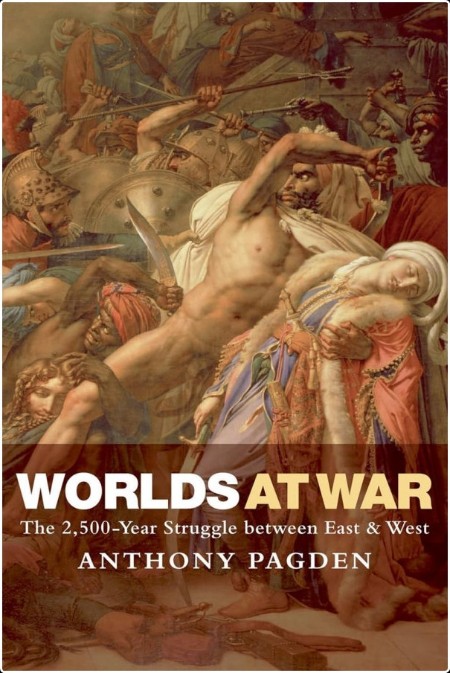
Worlds at War The 2,500 - Year Struggle Between East and West | 984.61 KB
Title: Worlds at War The 2,500 - Year Struggle Between East and West
Author: Anthony Pagden
Category: Nonfiction, Science & Nature, Science, Earth Sciences, Geography, History, Civilization, Social & Cultural Studies, Social Science, Anthropology
Language: English | 656 Pages | ISBN: 9781400060672
Description:
Spanning two and a half millennia, Anthony Pagden's mesmerizing Worlds at War delves deep into the roots of the "clash of civilizations" between East and West that has always been a battle over ideas, and whose issues have never been more urgent.
Worlds At War begins in the ancient world, where Greece saw its fight against the Persian Empire as one between freedom and slavery, between monarchy and democracy, between individuality and the worship of men as gods. Here, richly rendered, are the crucial battle of Marathon, considered the turning point of Greek and European history; the heroic attempt by the Greeks to turn the Persians back at Thermopylae; and Salamis, one of the greatest naval battles of all time, which put an end to the Persian threat forever.
From there Pagden's story sweeps to Rome, which created the modern concepts of citizenship and the rule of law. Rome's leaders believed those they conquered to be free, while the various peoples of the East persisted in seeing their subjects as property. Pagden dramatizes the birth of Christianity in the East and its use in the West as an instrument of government, setting the stage for what would become, and has remained, a global battle of the secular against the sacred. Then Islam, at first ridiculed in Christian Europe, drives Pope Urban II to launch the Crusades, which transform the relationship between East and West into one of competing religious beliefs.
Modern times bring a first world war, which among its many murky aims seeks to redesign the Muslim world by force. In our own era, Muslims now find themselves in unwelcoming Western societies, while the West seeks to enforce democracy and its own secular values through occupation in the East. Pagden ends on a cautionary note, warning that terrorism and war will continue as long as sacred and secular remain confused in the minds of so many.
Eye-opening and compulsively readable, Worlds at War is a stunning work of history and a triumph of modern scholarship. It is bound to become the definitive work on the reasons behind the age-old and still escalating struggle that, more than any other, has come to define the modern world-a book for anyone seeking to know why "we came to be the way we are."
From Publishers Weekly
In the pessimistic words of the ancient historian Herodotus, there will ever be perpetual enmity between the globe's two halves. Pagden ( Peoples and Empires ), a professor of political science and history at UCLA, tackles the immense sweep of 2,500 years of bad blood and seeks to explain the feud's continuing existence despite the increasing erosion of national differences. Does the trouble have geographical roots, or might it stem from religious differences? Pagden is convinced that in fact East and West are separated more by values and culture than by anything else-democratic vs. authoritarian rule, secular vs. theocratic and, later, Christian vs. Muslim. Though some readers might cavil at Pagden's reductionist assertion that religion has caused more lasting harm to the human race than any other single set of beliefs, his book is an accessible and lucid exploration of the history of the East-West split, concluding with a nuanced look at the divisions and misapprehensions that continue to the present time. Fans of Jacques Barzun and Jared Diamond will be most impressed by Pagden's big picture perspective. (Mar. 4)
Copyright © Reed Business Information, a division of Reed Elsevier Inc. All rights reserved.
From Booklist
Plumbing millennia of conflict between European civilizations and those of the Near East, historian Pagden outlines historical antecedents to present frictions between the secular West and the Muslim world. If the collisions between Greek and Persian, Roman and barbarian, Christian and pagan, Christian and Muslim, and imperialist and nationalist have something in common, according to Pagden, it is the rivalry of universalistic ideas about humanity and providence. Through each of these pairs of opposites, Pagden introduces intellectuals of the age who puzzled over their cultural adversary, often in response to a calamity, such as the Crusaders' capture of Jerusalem in 1099 or the Ottoman conquest of Constantinople in 1453. Their analyses, whose realism or logic Pagden critiques, for returning humanity to its providential destination, be it Christianity, Islam, or liberal democracy, slot into the author's chronological narrative of major exacerbations of West-East animosity, from the Trojan War to the Iraq War. Inquisitive and incisive about the sweep of history, Pagden will connect with readers wanting to deepen their grasp of contemporary news. --Gilbert Taylor
Review
"Bold, panoramic and highly readable, at times a page-turner."
-The New York Times Book Review
"A masterpiece of stunning scope, readability, and relevance. Worlds at War makes epic battles of the past come alive as illuminations of what is happening today in Iraq, Iran, and Afghanistan."
-Strobe Talbott, author of The Great Experiment
"A grand synthesis of military and intellectual history, political philosophy and theology, Worlds at War delivers the old-fashioned pleasures of vivid prose and lively narration."
-Newsday
"Absorbing . . . Pagden writes smart, fluent, lively prose. His book is a pleasure to read."
-The Houston Chronicle
"If you are going to read only one book on the Manichaean struggle between East and West, this is the book."
-Efraim Karsh, author of Islamic Imperialism: A History
"Splendid . . . learned, fluent and thoroughly entertaining."
- National Post (Canada)
"Timely and provocative . . . enlightening."
-Cleveland Plain Dealer
Winner of the Washington Institute for Near East Policy Book Prize
From the Trade Paperback edition.
About the Author
Anthony Pagden is a professor in the history and political science departments at the University of California, Los Angeles and the author of Peoples and Empires.
John Lee has read audiobooks in almost every conceivable genre, from Charles Dickens to Patrick O'Brian, and from the very real life of Napoleon to the entirely imagined lives of sorcerers and swashbucklers. An AudioFile Golden Voice narrator, he is the winner of numerous Audie Awards and AudioFile Earphones Awards.
DOWNLOAD:
Spanning two and a half millennia, Anthony Pagden's mesmerizing Worlds at War delves deep into the roots of the "clash of civilizations" between East and West that has always been a battle over ideas, and whose issues have never been more urgent.
Worlds At War begins in the ancient world, where Greece saw its fight against the Persian Empire as one between freedom and slavery, between monarchy and democracy, between individuality and the worship of men as gods. Here, richly rendered, are the crucial battle of Marathon, considered the turning point of Greek and European history; the heroic attempt by the Greeks to turn the Persians back at Thermopylae; and Salamis, one of the greatest naval battles of all time, which put an end to the Persian threat forever.
From there Pagden's story sweeps to Rome, which created the modern concepts of citizenship and the rule of law. Rome's leaders believed those they conquered to be free, while the various peoples of the East persisted in seeing their subjects as property. Pagden dramatizes the birth of Christianity in the East and its use in the West as an instrument of government, setting the stage for what would become, and has remained, a global battle of the secular against the sacred. Then Islam, at first ridiculed in Christian Europe, drives Pope Urban II to launch the Crusades, which transform the relationship between East and West into one of competing religious beliefs.
Modern times bring a first world war, which among its many murky aims seeks to redesign the Muslim world by force. In our own era, Muslims now find themselves in unwelcoming Western societies, while the West seeks to enforce democracy and its own secular values through occupation in the East. Pagden ends on a cautionary note, warning that terrorism and war will continue as long as sacred and secular remain confused in the minds of so many.
Eye-opening and compulsively readable, Worlds at War is a stunning work of history and a triumph of modern scholarship. It is bound to become the definitive work on the reasons behind the age-old and still escalating struggle that, more than any other, has come to define the modern world-a book for anyone seeking to know why "we came to be the way we are."
From Publishers Weekly
In the pessimistic words of the ancient historian Herodotus, there will ever be perpetual enmity between the globe's two halves. Pagden ( Peoples and Empires ), a professor of political science and history at UCLA, tackles the immense sweep of 2,500 years of bad blood and seeks to explain the feud's continuing existence despite the increasing erosion of national differences. Does the trouble have geographical roots, or might it stem from religious differences? Pagden is convinced that in fact East and West are separated more by values and culture than by anything else-democratic vs. authoritarian rule, secular vs. theocratic and, later, Christian vs. Muslim. Though some readers might cavil at Pagden's reductionist assertion that religion has caused more lasting harm to the human race than any other single set of beliefs, his book is an accessible and lucid exploration of the history of the East-West split, concluding with a nuanced look at the divisions and misapprehensions that continue to the present time. Fans of Jacques Barzun and Jared Diamond will be most impressed by Pagden's big picture perspective. (Mar. 4)
Copyright © Reed Business Information, a division of Reed Elsevier Inc. All rights reserved.
From Booklist
Plumbing millennia of conflict between European civilizations and those of the Near East, historian Pagden outlines historical antecedents to present frictions between the secular West and the Muslim world. If the collisions between Greek and Persian, Roman and barbarian, Christian and pagan, Christian and Muslim, and imperialist and nationalist have something in common, according to Pagden, it is the rivalry of universalistic ideas about humanity and providence. Through each of these pairs of opposites, Pagden introduces intellectuals of the age who puzzled over their cultural adversary, often in response to a calamity, such as the Crusaders' capture of Jerusalem in 1099 or the Ottoman conquest of Constantinople in 1453. Their analyses, whose realism or logic Pagden critiques, for returning humanity to its providential destination, be it Christianity, Islam, or liberal democracy, slot into the author's chronological narrative of major exacerbations of West-East animosity, from the Trojan War to the Iraq War. Inquisitive and incisive about the sweep of history, Pagden will connect with readers wanting to deepen their grasp of contemporary news. --Gilbert Taylor
Review
"Bold, panoramic and highly readable, at times a page-turner."
-The New York Times Book Review
"A masterpiece of stunning scope, readability, and relevance. Worlds at War makes epic battles of the past come alive as illuminations of what is happening today in Iraq, Iran, and Afghanistan."
-Strobe Talbott, author of The Great Experiment
"A grand synthesis of military and intellectual history, political philosophy and theology, Worlds at War delivers the old-fashioned pleasures of vivid prose and lively narration."
-Newsday
"Absorbing . . . Pagden writes smart, fluent, lively prose. His book is a pleasure to read."
-The Houston Chronicle
"If you are going to read only one book on the Manichaean struggle between East and West, this is the book."
-Efraim Karsh, author of Islamic Imperialism: A History
"Splendid . . . learned, fluent and thoroughly entertaining."
- National Post (Canada)
"Timely and provocative . . . enlightening."
-Cleveland Plain Dealer
Winner of the Washington Institute for Near East Policy Book Prize
From the Trade Paperback edition.
About the Author
Anthony Pagden is a professor in the history and political science departments at the University of California, Los Angeles and the author of Peoples and Empires.
John Lee has read audiobooks in almost every conceivable genre, from Charles Dickens to Patrick O'Brian, and from the very real life of Napoleon to the entirely imagined lives of sorcerers and swashbucklers. An AudioFile Golden Voice narrator, he is the winner of numerous Audie Awards and AudioFile Earphones Awards.
DOWNLOAD:
Code:
Code: